
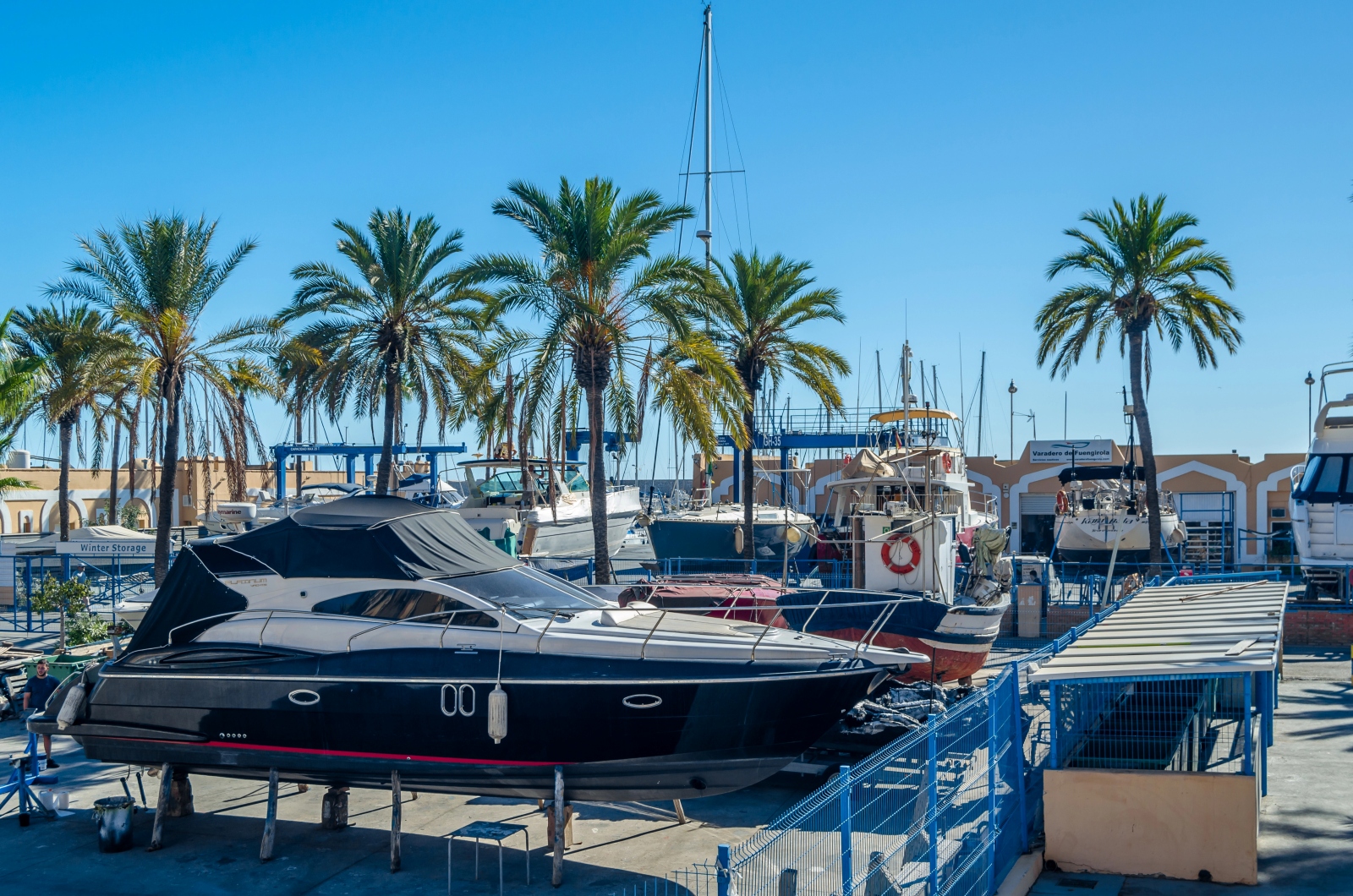
When it comes to the sea, it remains the ultimate judge.
No ad or glossy brochure can convince the elements that a cover is well made.
Out on the water, everything becomes brutally simple: a tent either holds or it fails.
That’s why the perfect marine cover isn’t just fabric and fittings — it’s the result of engineering integrity, millimeter precision, and deep respect for the sea.
🧵 Materials as a Philosophy of Strength
A modern marine cover is far more than a piece of acrylic. It’s a composite, engineered textile designed to fight the elements.
Professionals rely on fabrics like Sunbrella®, Sauleda®, WeatherMax®, and Sattler®, each with its own character and advantages.
- Fabric density: 300–600 g/m²
- Tensile strength: 2500–3200 N/5 cm
- Water repellency: ≥ 90%
- Colorfastness: up to 1200 hours under direct UV radiation
Acrylic fabrics excel in hot climates — breathable, light, and resistant to the greenhouse effect.
Polyester and Cordura work best in northern zones, where moisture resistance and mold protection matter most.
Professionally speaking, a fabric should work with the wind, not against it — that’s what preserves geometry and tension over years of use.
For instance, a boat cover for a runabout made from Sunbrella® marine acrylic can withstand gusts up to 80 km/h and maintain its tension after hundreds of folding cycles.
🔩 Frame & Hardware — The Engineering of Reliability
The frame is the skeleton of every cover. Mistakes here are fatal.
For yachts and motorboats, the most common frame materials include:
- AISI 316 stainless steel — corrosion-proof for saltwater use,
- aluminum 6061 — lightweight for smaller crafts,
- carbon fiber — for premium yachts and high-load designs.
Frame diameter depends directly on surface area and expected wind load:
- Ø 22–30 mm for small boats;
- Ø 35–45 mm for yachts over 10 m;
- bending resistance exceeds 150 kg/cm².
Fasteners aren’t just accessories — they’re points of structural integrity: Tenax, Lift-the-Dot, Keder rails, and YKK Marine zippers.
A single misplaced eyelet under stress can compromise the entire setup.
By the way, when designing a convertible cover for a yacht with a sliding frame, engineers must account for the frame height and sail-like wind profile to prevent overload on mounting points.
📏 Measurement & Patterning — Mathematics of Precision
The creation of a perfect boat tent begins not with cutting fabric but with precise measurement.
Modern production uses:
- 3D hull scanning with ArUco markers and photogrammetry,
- laser marking accurate to ±1 mm,
- and traditional methods — tape measurements with diagonal verification.
Angles, radii, and rail curves all affect fabric fitting.
Even acrylic shrinkage after tensioning (≈1.5–2 %) must be factored in.
In essence, measurement accuracy is the foundation — without it, even the most expensive fabric will fail.
This is especially critical when producing a cockpit tent for a motorboat with transparent panels and removable side curtains — an error of just 3–4 mm can distort the zippers and create dangerous wind drag.
🪑 Beyond the Classic Tent: Furniture, Curtains & Modular Systems
Modern yachts have long moved beyond simple cockpit covers.
Owners now demand furniture re-upholstery, outdoor curtains, side modules, and backdrop tents as part of a unified aesthetic system.
For soft zones, fabrics like Nautolex®, Spradling®, and Stamoid Heavy Cover dominate — resistant to salt, UV, and abrasion (>100 000 Martindale cycles).
Outdoor curtains are often made from 700-micron transparent PVC or TPU film,
sometimes with mesh inserts and wind-release flaps.
For comfort — zippered “windows”, ventilation panels, and foldable modular sections.
At the dock, a parking cover for pontoons with sectional hybrid design is an excellent solution — it shields the deck from rain while allowing easy technical access for maintenance.
⚙️ Craftsmanship in Numbers
If we speak factually, the philosophy of the perfect tent is measured in numbers:
- Fabric tension during installation: 8–12 kg per line
- Seams: double-stitched, Tenara® PTFE thread
- Quality control tests: AATCC 22 (water repellency), Q-SUN (UV durability)
- Allowable deformation: ≤ 1 %
Accuracy in cutting, uniform fabric tension, and clean seams determine whether a tent lasts ten seasons or tears after one.
The sea forgives beauty — but not sloppiness.
🌊 In Essence: Engineering with a Soul
A yacht or boat tent of premium class is not just about protection — it’s a symbol of precision, design, and craftsmanship.
The sea immediately senses where there’s negligence and where there’s mastery.
And when everything is made with honesty — the fabric sings in the wind, the seams stay silent, and the lines look as though they’ve always belonged to the vessel.
The sea doesn’t forgive sloppiness. But it always rewards those who build with soul. ⚓
Our Projects Geography