Smart Shade: How Technology Changed the Concept of a Bimini
Just a decade ago, a bimini tent on a yacht was associated with manual mechanisms, creaking frame arches, and a bit of a morning workout for the captain.
Today, things have changed dramatically.
Modern automatic bimini for yachts operate quietly, smoothly, and almost theatrically — just press a button, and a soft shadow unfolds over the deck as if on cue from a director 🎭
If we speak frankly, motorization has affected almost every type of bimini — from classic folding models to advanced retractable tent systems with electric drive featuring touch controls and hydraulic actuators.
How It Works: Electronics vs. Hydraulics
Electric systems are simpler to install and maintain — and, most importantly, they take up less space.
Electric bimini tents for yachts are ideal for mid-sized vessels: control is performed via remote, control panel, or even smartphone. By the way, they can easily be integrated into a smart-yacht system — allowing the bimini to react automatically to weather conditions.
Hydraulic structures, on the other hand, are a different story — a higher league.
Hydraulic yacht tent systems manage not only motion but also damping during gusty winds.
Water and oil work together here like two dance partners — silent but powerful.
Comfort Under Control: Sensors, Remotes, and Smart Automation
Even if we set engineering aside for a moment, it’s clear that automatic bimini tents for yachts have changed the very philosophy of leisure at sea.
Now shade can be summoned with a simple gesture:
- 🕹️ via remote control,
- 📱 through a smartphone,
- 🌬️ or entrusted entirely to wind and sunlight sensors.
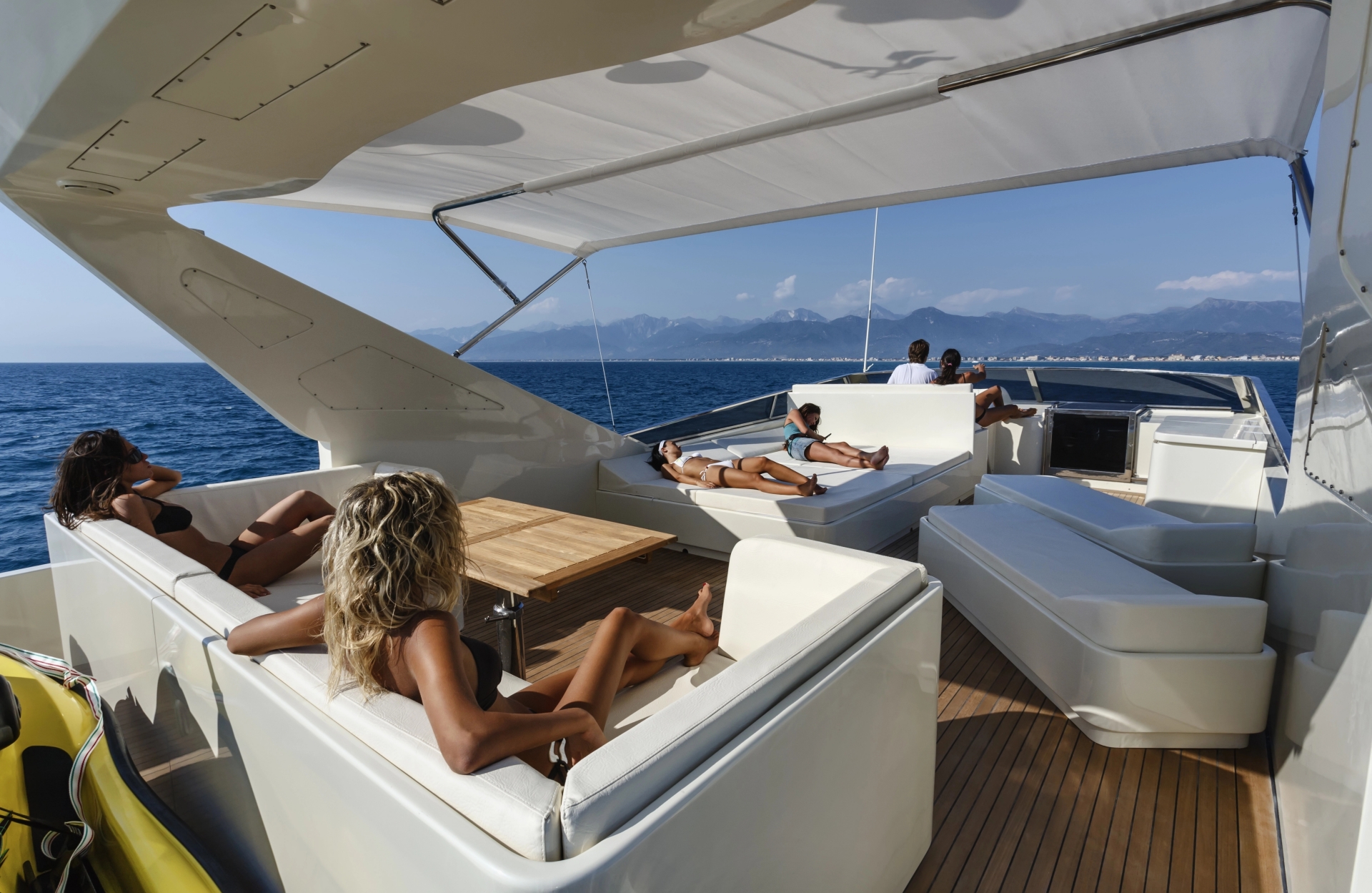
Imagine this: you’re anchored off the coast of Sardinia. The wind rises — and the tent automatically retracts before you even react. When the sun calms down again, it gracefully unfolds back into position.
Functionally speaking — it’s no longer just an accessory, but a complete microclimate system on board.
Materials and Brands: Where Engineering Meets Aesthetics
Of course, what’s the point of technology if we forget about fabric?
After all, the fabric defines the “face” of the bimini.
For motorized constructions, lightweight yet durable materials are used: acrylic, Cordura, polyester, and nylon — all with UV- and water-resistant coatings.
Here reign the masters — Sunbrella®, Sauleda®, WeatherMax®, Sattler® — fabrics renowned for their resistance to fading, salt air, and mechanical stress.
These materials don’t just protect; they visually emphasize the yacht’s style.
Color, texture, sheen — every detail is designed so that even when folded, a motorized bimini tent looks less like a mechanism and more like a refined design element 💫
Engineering with Grace: The Aesthetics of Motion
Smooth lines, frame symmetry, and above all — mechanical precision.
Every automatic yacht sunshade tent is a miniature engineering performance.
Imagine switching on the system: hydraulic cylinders begin to move, the fabric unfolds, and in just seconds — a perfect shade forms over the deck.
All this is accompanied by a soft motor hum — the whisper of technology made to serve comfort.
Add LED lighting along the arcs, and you get a lounge-like evening ambiance that “beautifully harmonizes” with a glass of wine and the sound of waves.
In Essence: The Shade of the Future Is Already on Board
In essence, the automatic bimini has long ceased to be just a cover.
It’s a statement of status, a piece of engineering art, and, without exaggeration, the final touch in a yacht’s silhouette.
A professional approach to measurements and patterning determines everything — from geometry to fabric tension.
Ultimately, a smart yacht bimini tent should not only provide protection but also visually reflect the owner’s status with style.
So, speaking professionally — the smart shade is now controlled not by hand, but with a single touch 😉
Our Projects Geography