
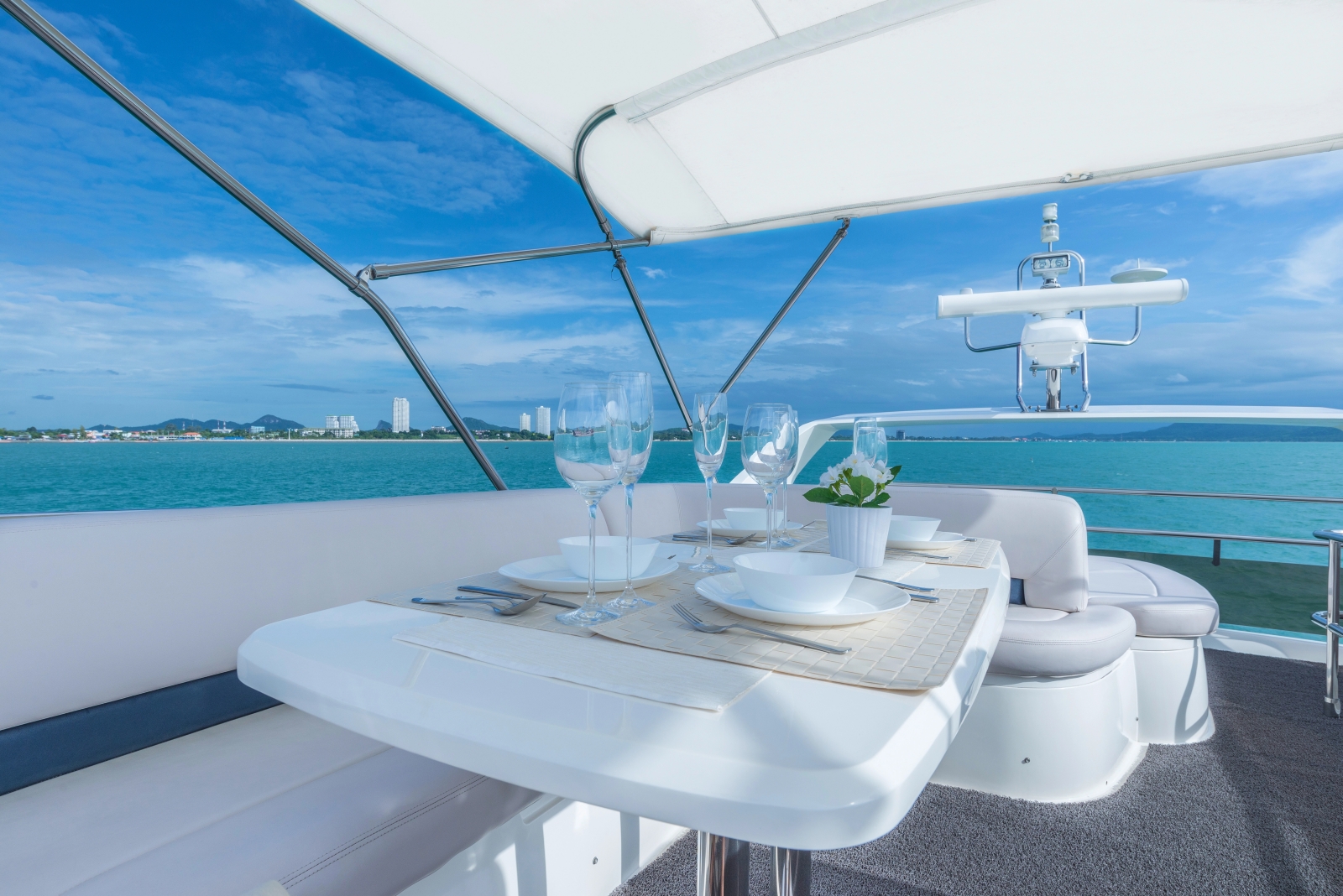
When you look at modern yachts, it becomes clear that a tent is no longer just protection from the sun or rain. It’s an architectural element, a part of the design, and sometimes even the yacht’s visual signature. In essence, yacht covers have turned into a language of shapes, lines, and proportions — a dialogue between engineering and aesthetics.
🧭 The Tent Style as a Continuation of Deck Architecture
Speaking professionally, today’s tent systems are tailored to the hull geometry with millimeter precision. The angle of fabric tension is typically around 18–22°, ensuring even water runoff and minimal wind resistance. Polished stainless steel AISI 316 frame tubes can withstand lateral wind pressure up to 180 kg/cm².
By the way, in terms of aesthetics — premium yacht tents visually extend the deck lines, emphasizing the harmony of the vessel’s silhouette. Light acrylic shades make the yacht appear more airy, while deeper tones like sand or graphite add a sense of sophistication and presence.
⚙️ Materials That Define Style
In the marine tent segment, fabric is not just a textile — it’s an engineered material. For example, acrylic tent fabrics like Sunbrella® or Sauleda® can withstand a hydrostatic pressure of 1000–1200 mm and tensile strength up to 300 N/5 cm under horizontal load. This keeps the fabric stable and prevents sagging, even under long-term sun and moisture exposure.
For smaller boats and cruisers, synthetic composites like WeatherMax® or Sattler® are often used — they block up to 98% of UV-A/B rays, are water-repellent, and breathable, preventing the greenhouse effect.
Thus, marine tent structures today are not made “by eye,” but with precise calculations of tension, torque, and wind loads.
💡 Architecture and Functionality
Now, let’s talk about frame tents for boats. They have evolved beyond simple protection to become part of the yacht’s architectural composition — the rhythm, balance, and geometry of the vessel. Every curve matters: from the installation angle of the supports to the radius of the arches.
Many yacht builders now integrate the tent framework directly into the deck structure. Mounting points are flush with the surface, maintaining the clean, seamless lines of the yacht. Even the hardware has become a design statement — polished steel, anodized aluminum, hidden fasteners. Together, these details define that distinct “architectural handwriting.”
🌅 Premium as a Philosophy of Form
In essence, premium yacht coverings influence the perception of a yacht as much as its hull shape. These are not just protective systems — they are emotional accents, visual poetry in motion.
Without exaggeration, a yacht without a properly fitted tent feels like a penthouse without panoramic windows. Everything seems fine, but something’s missing — that sense of completion, of harmony.
⚓ In Essence: Engineering Meets Art
Ultimately, tent architecture on water is a fusion of engineering precision and artistic vision. A world where tensile strength (up to 2500 N/5 cm), water repellency (≥90%), and color fastness (up to 1200 hours of direct sunlight) meet the aesthetics of lines and light.
It’s impossible to overestimate this — that’s where true marine beauty begins. 🌊
Our Projects Geography